
Pet journal guide
What should you record in a daily pet journal?
A useful pet journal does not need to capture every movement. Record the few things that help you remember a normal day, notice a change, and provide useful context when something feels different.
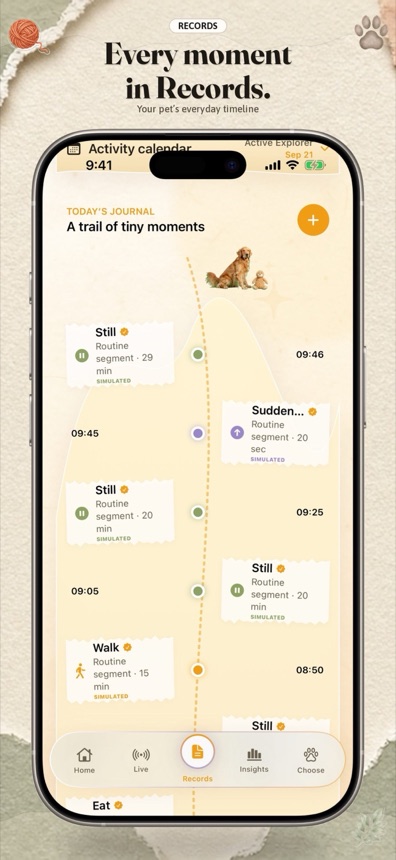
The short version: start with meals, activity, rest, and one short note about anything unusual. Add context such as visitors, travel, weather, or a change in routine. The best journal is the one you can keep on an ordinary day.
Start with four anchors
1. Food and water
Record meals, treats, and any notable change in appetite or drinking. You do not need to measure every bite. A short note such as "breakfast finished" or "left half of dinner" is often more useful than a pile of uncertain numbers.
2. Activity
Note walks, active play, and unusually long periods of stillness. For a cat, that might include climbing, chasing, or a burst of activity at night. For a dog, it might include a familiar walking route, a new park, or a play session that was more intense than usual.
3. Rest
Sleep and rest are easy to overlook because they are quiet. Record changes in sleeping location, duration, or daytime rest if they stand out. You do not need to track every nap.
4. One useful note
Write one sentence that would help you remember the day later. It might describe a new behavior, a reaction to a visitor, a change in routine, or a moment that made you smile. This small note often provides more context than an automatic label ever can.
Add context, not diagnosis
A journal becomes more useful when it records the conditions around a change. Consider adding:
- visitors, workers, or a change in household routine;
- travel or a new environment;
- weather that affected outdoor time;
- a new food, toy, bed, or litter;
- grooming, medication, or a veterinary appointment;
- a specific observation you want to ask about later.
Keep the language descriptive. "Paced near the door for ten minutes after a visitor arrived" is a useful observation. "Anxious" may be your interpretation, and a journal becomes more valuable when observation and interpretation are not mixed together.
Use a five-minute daily review
You do not need to carry the journal around all day. A short review can be enough:
- Add the main meal or feeding moments you remember.
- Add walks, play, or other significant activity.
- Add any unusual rest or behavior.
- Write one short context note.
- Leave the rest alone.
If a day is uneventful, a small entry is enough. Consistency matters more than detail, especially if you want to compare one week with another.
How much detail is too much?
A journal can become a source of stress if every entry feels mandatory. Symptoms of overlogging include writing the same routine in several places, avoiding the journal because the backlog is too large, or treating a missed day as a failure.
A simpler standard works better: record what you would want to know two weeks from now. If a detail will not help you remember the day, spot a pattern, or provide context for a veterinary conversation, it may not need to be in the journal.
Review the week, not just the day
The daily timeline is useful for memory. The weekly view is useful for context. At the end of a week, look for broad changes rather than judging individual entries:
- Was activity generally similar or different?
- Were meals and rest roughly consistent?
- Did a new behavior appear more than once?
- Did a change overlap with travel, visitors, weather, or a new routine?
- Is there a question you want to ask a veterinarian?
Patterns can be easier to discuss when you have dates and examples. A journal does not need to explain the pattern by itself.
What manual notes add to automatic activity
Automatic activity estimates can provide broad context, but they cannot know that a visitor arrived, that the food changed, or that a pet seemed unusually interested in a particular room. Manual notes capture the parts software cannot observe.
In Furroam, manual entries, Watch estimates, and simulated companion behavior are labeled separately. That separation keeps a digital pet's storyline from being mistaken for a real event, and it keeps an estimate from looking like a confirmed observation.
Keep it for you, not for a score
The point of a pet journal is not to optimize a pet's day or earn a streak. It is to give you a calmer way to remember routines, notice changes, and bring better context to a conversation when you need one.
Start small. The journal can become more detailed only if that detail is genuinely useful. A few honest entries are more valuable than a perfect record that becomes impossible to maintain.
Next step: see the Furroam pet journal, or read how an Apple Watch can add optional activity context.