
Cat activity guide
A cat activity journal for the quiet parts of the day.
Cats can spend most of the day still, hidden, or moving in short bursts. A useful journal does not try to turn every nap into a metric. It records enough context to notice a routine and remember what changed.
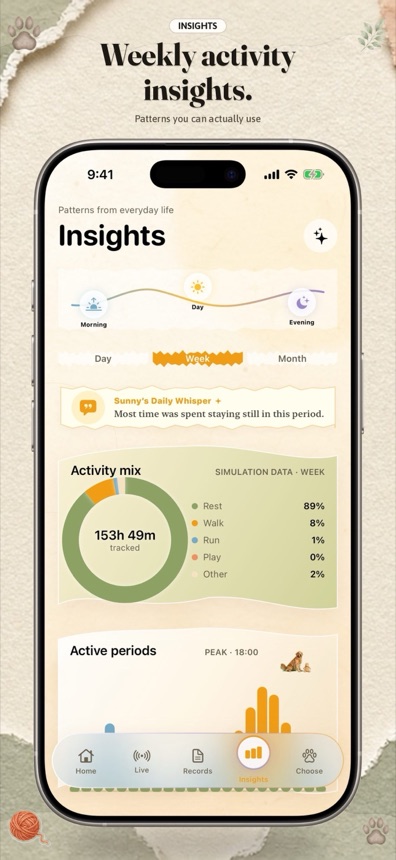
The short version: record meals, play, long rest periods, and one observation about the day. Add context such as a new toy, visitors, weather, or a change in routine. Review the week for patterns, not perfection.
Why a cat journal is different
A dog walk often has a clear beginning and end. A cat's day is more distributed. A short burst of play can happen between long periods of rest. A change in appetite may be easier to notice than a change in step count.
That makes manual context especially valuable. A motion estimate can show that a cat was active or still, but it cannot know that the cat avoided a new food, spent more time under the bed, or suddenly preferred a different sleeping spot.
What to record
Meals and water
Note the main meals and any clear change in appetite or drinking. You do not need to measure every bite. "Finished breakfast" or "left most of dinner" is often enough.
Play and movement
Record active play, climbing, chasing, or an unusual burst of energy. A few minutes with a favorite toy can be more meaningful than a generic step count because it includes the context of what the cat was doing.
Rest and hiding places
Long rest is normal for many cats. What matters is a change from the usual pattern: sleeping in a different room, hiding more often, or becoming unusually difficult to rouse. Record the observation without trying to diagnose it.
Grooming and repetitive behavior
A short note can capture scratching, over-grooming, pacing, or another repeated action. If something concerns you, a dated record can help you describe it to a veterinarian.
One daily observation
Write a single sentence that would help you remember the day. It might be a new hiding spot, a reaction to a visitor, or a moment of play that was different from the usual routine.
Use context instead of conclusions
"Stayed under the bed for most of the afternoon after the workers arrived" is an observation. "Anxious" is an interpretation. Both may be relevant, but the observation is more useful when you look back later.
Context can include visitors, travel, weather, a new litter, a changed feeding time, medication, or a veterinary appointment. You do not need to write an essay. A few words are enough.
How automatic activity fits
When a compatible Apple Watch is worn by a cat, Furroam can use supported motion and sound signals to estimate activity. The estimate is optional and should not be treated as a complete record of behavior.
A cat may move without walking, be still without sleeping, or hide without showing a health problem. The journal helps preserve the context that the sensor cannot see. Manual and Watch-based entries remain labeled separately in Furroam.
A five-minute weekly review
- Look at the main meals and note any repeated change.
- Scan play and activity for a clear increase or decrease.
- Compare rest and hiding places with the previous week.
- Check whether a change overlaps with visitors, weather, or a new routine.
- Write one question or observation you want to remember.
The weekly review is not a diagnosis. It is a way to notice patterns and prepare a better conversation if you decide to speak with a veterinarian.
Keep the journal small
The best journal is the one you can keep on an ordinary day. Start with four anchors: food, play, rest, and one note. Add more detail only if it helps you answer a question.
A missed day is not a failure. A short, honest entry after a quiet day is enough. The goal is a gentle memory aid, not a perfect performance record.
Next step: see the Furroam pet journal, or read the lighter guide to daily pet notes.