
Dog walking guide
A dog walking log that stays useful after the walk.
A walking log is more than a list of minutes. It can help you remember changes in routine, compare active and quiet days, and bring better context to a conversation about your dog's habits.
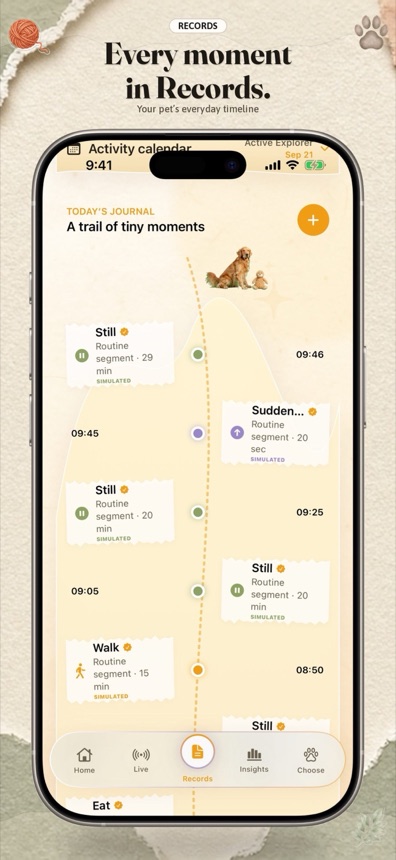
The short version: record the time, duration, rough activity level, and one useful note. Add context such as weather, a new route, visitors, or a change in the dog's behavior. Review the week instead of judging a single walk.
Why keep a dog walking log?
Most walks do not need to become data. A log becomes useful when it helps you answer a question later: Was this week quieter than usual? Did the long walk happen before or after the change in appetite? Did the dog seem more tired after a new route?
It is also a memory aid. The small details of an ordinary day are easy to lose. A short note about the weather, a new sniffing spot, or a friend met at the park can make the record feel alive without adding much work.
The five fields worth keeping
1. Time and duration
Write down when the walk started and roughly how long it lasted. A range is fine if you did not check the clock. The goal is a useful pattern, not false precision.
2. Activity level
Use a simple description such as slow sniffing walk, steady walk, or active play. A subjective label is more useful than a large set of measurements you will not maintain.
3. Route or place
You do not need a GPS trace. "Usual block," "park," "new trail," or "indoor play" is enough to compare one day with another. If you want route-level location tracking, use a product designed for that purpose.
4. Conditions
Heat, rain, wind, crowds, and unusual noise can change a walk. A brief context note makes the record more useful and avoids treating every change as a behavior problem.
5. One observation
Add one sentence about what stood out. It might be a long sniff, a hesitation, an enthusiastic greeting, or a quiet return home. Descriptive language is better than assuming a medical or emotional cause.
A two-minute example
18:10 · Walk · 25 min · Steady
Usual block and park. Warm evening, fewer people than usual. Sniffed more near the east gate, then walked home at a normal pace. Drank water after returning.
That entry is enough to remember the walk and compare it with another day. It does not require a wearable, a route map, or a long questionnaire.
How automatic activity can fit
A compatible Apple Watch can add a broad activity estimate to the same day. Treat it as context, not as a replacement for your observation. The Watch does not know that the park was crowded, that the route was new, or that your dog stopped to watch another animal.
In Furroam, manual entries and Watch-based estimates are labeled separately. That distinction matters when you look back later.
Review the week, not the minute
Once a week, look at the broader pattern:
- Were walks generally shorter, longer, or more varied?
- Were there several days with less activity than usual?
- Did a change overlap with weather, visitors, travel, or a new routine?
- Did rest, appetite, or play change at the same time?
- Is there a specific observation you want to discuss with a veterinarian?
A weekly review is more useful than a daily score. It gives you a chance to notice a pattern without turning every walk into a performance metric.
What not to do
Do not treat a missed entry as a failure. Do not use a walking log to diagnose pain, illness, anxiety, or a behavior problem. Do not assume that a lower step estimate means a worse day, or that a higher one means a healthier dog.
The log is a record of observations and context. It helps you ask better questions, not answer medical ones by yourself.
Start with the next walk
You do not need to reconstruct weeks of history. Add one entry after the next walk: time, duration, activity level, place, and one observation. If that takes less than two minutes, the habit is likely to survive an ordinary week.
Next step: use the Furroam pet journal for a daily timeline, or read how Apple Watch activity estimates work.